
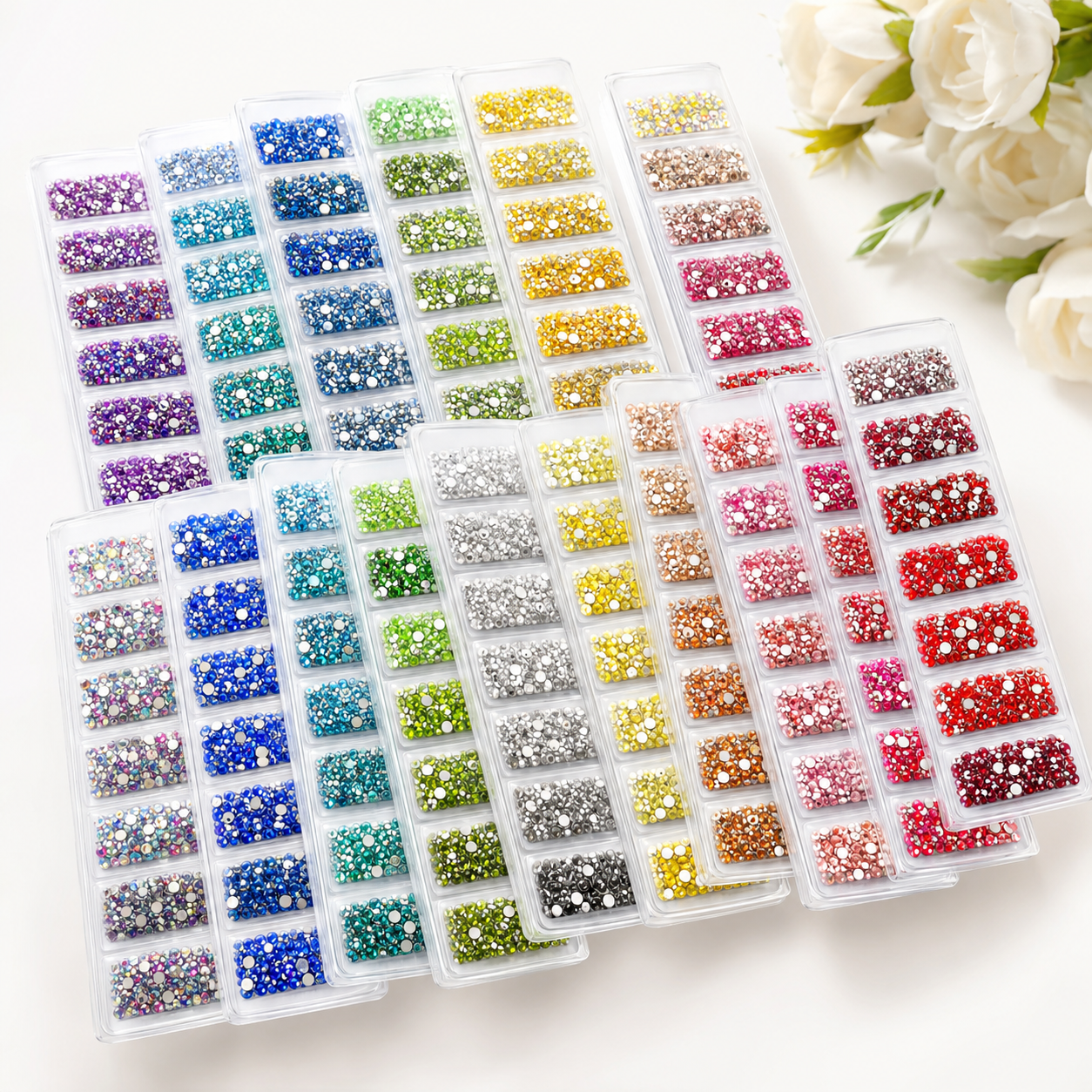
The same bag of hotfix rhinestones can produce decoration that survives fifty washes or decoration that starts shedding stones after the first one. Nothing about the stones differs. What differs is the glue layer and how the heat was applied to it.
How Hotfix Adhesion Actually Works
A hotfix stone carries a pre-applied layer of hot melt adhesive on its flat back. The adhesive is solid and non-tacky at room temperature. When heat is applied, it softens, wets the fabric surface and penetrates into the fibre structure. When it cools, it re-solidifies and forms a mechanical and chemical bond with the substrate.
Two things must both happen for that bond to hold: the adhesive has to reach its activation temperature throughout its thickness, and it has to penetrate the fabric rather than merely sitting on top of it. Failures almost always trace back to one of these two conditions not being met.
The Three Failure Modes
| Failure | What You See | Root Cause |
|---|---|---|
| Stone falls off intact | Whole stone detaches, glue remains clean | Adhesive never reached activation temperature, or cooled before contact |
| Stone falls off with fabric fibres | Fibre tufts stuck to the glue | Bond was stronger than the fabric; adhesive penetrated too deeply or heat was excessive |
| Stone stays but shifts | Decoration drifts or rotates out of alignment | Adhesive softened during a later heat cycle and was not held in position |
The second case is worth noting because it is frequently misdiagnosed as a glue defect. Delicate or loosely woven fabrics can fail before the adhesive does, and no change of stone will fix it. The correct response is a different attachment method, such as sew-on stones.
Matching Heat Settings to Fabric
Heat application is a three-variable process: temperature, time and pressure. Increasing any one of them without adjusting the others is how damage happens.
| Fabric | Heat Sensitivity | Practical Approach |
|---|---|---|
| Cotton and canvas | Tolerant | Higher temperature, standard dwell time |
| Polyester and blends | Sensitive to scorching | Lower temperature, longer dwell, test on offcut first |
| Denim | Tolerant | Higher temperature, firm pressure for penetration |
| PU leather and coated fabrics | Very sensitive | Lowest workable temperature, short dwell, protective cover sheet |
| Delicate knits and mesh | Poor heat tolerance | Consider sew-on stones instead of hotfix |
| Nail tips and resin | Not heat applied | Use flat back stones with adhesive suited to the substrate |
The standard garment procedure covers the arranged stones with a cotton cloth and applies heat for roughly ten to twenty seconds to fully melt the adhesive layer. The cover cloth is not optional — it prevents the iron or press plate from sticking to exposed adhesive and dragging the stones out of position.
Why Cooling Matters as Much as Heating
Adhesive strength develops during cooling, not during heating. Handling the garment while the glue is still soft is a common cause of misalignment and of stones being pushed sideways into neighbouring positions. Leave the piece to cool completely and undisturbed before moving it.
The same logic applies to stacked or folded work. Packing decorated garments while warm causes stones to bond to whatever they touch, and the failure is only discovered by the end customer.
Washing and Care After Application
Wash resistance is a property of a correctly formed bond, not of the stone. Once the bond is sound, care practice determines how long it lasts.
- Turn the garment inside out before washing so mechanical abrasion is directed away from the decorated face.
- Wash cold and gentle. Hot water softens the adhesive and reopens the bond.
- Avoid harsh scrubbing on decorated areas; abrasion dulls the coating as well as stressing the glue.
- Skip high heat drying. Tumble drying at high temperature is the single fastest way to loosen a sound bond.
- Avoid fabric softener on decorated areas where possible, as it leaves a residue on the coating surface.
What to Verify with an Installation Trial
Before committing a production run, run a small trial that reproduces the real conditions.
- Test on the actual fabric, including the actual dye lot, run through the actual pressing equipment.
- Run the real wash cycle the finished product will face, then inspect for detached and shifted stones.
- Check for fabric damage such as scorching, glazing or print lifting around the decorated area.
- Confirm alignment after cooling, not immediately after pressing, to catch drift caused by handling too early.
- Record the settings — temperature, time, pressure and cover material — so the trial becomes a repeatable production standard.
Choosing the Right Stone for the Process
Where the production process cannot be tightly controlled, the stone choice should compensate. Uniform, consistent adhesive backing matters more in high-volume pressing operations than in small craft batches, because a single underheated stone in a densely packed pattern is enough to start a chain of shedding.
Pairing the correct backing type with a controlled heat process, and then verifying it with a trial on the real fabric, is what separates decoration that looks good in the sample room from decoration that still looks good after a year of wear.