
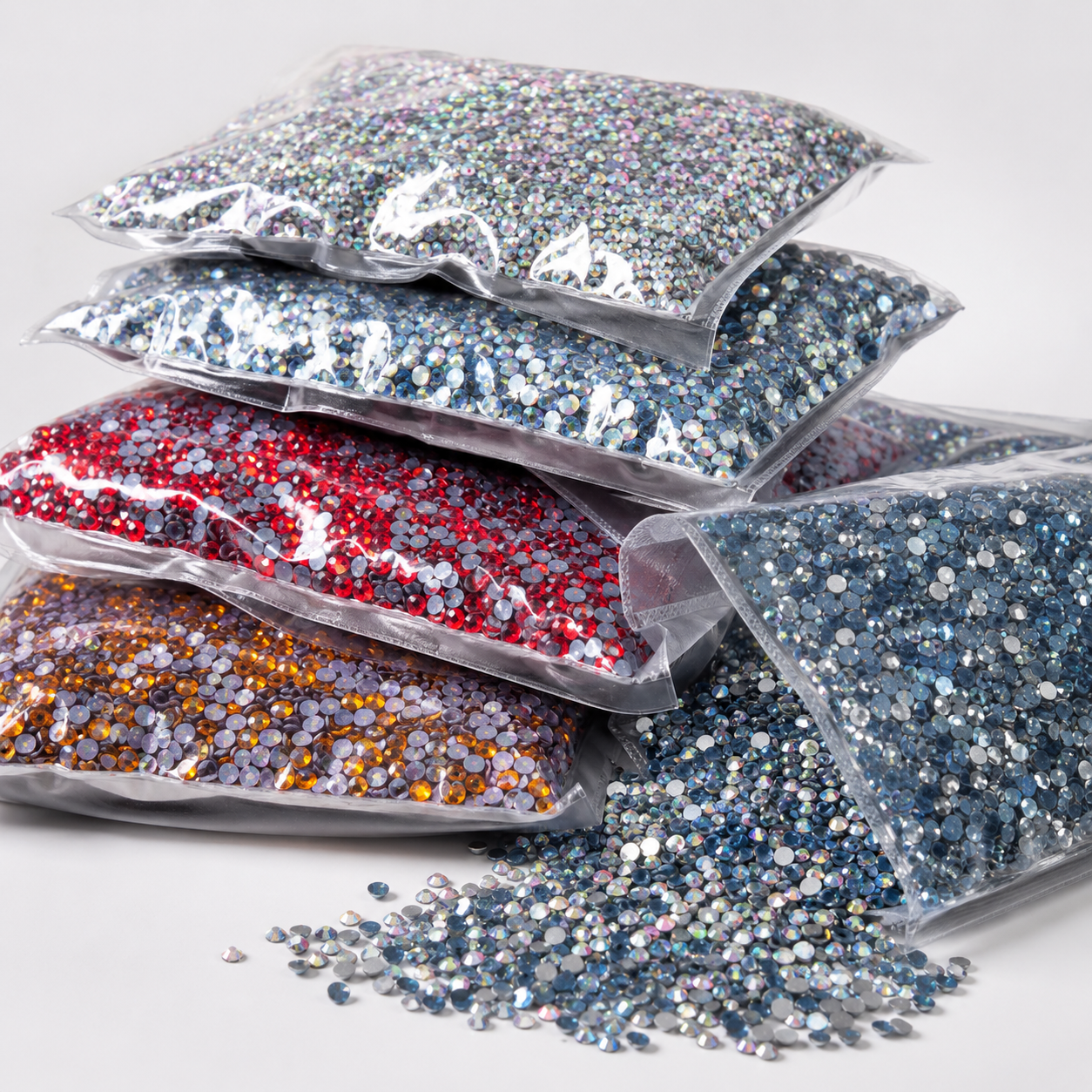
Two rhinestones can look identical in a photograph and behave completely differently after twenty wash cycles. The difference is almost never the stone itself — it is the coating. Vacuum coating is the step that gives a rhinestone its colour, its mirror brightness and its resistance to discolouration, and it is also the step that is hardest to verify from a supplier catalogue.
What Vacuum Coating Actually Does
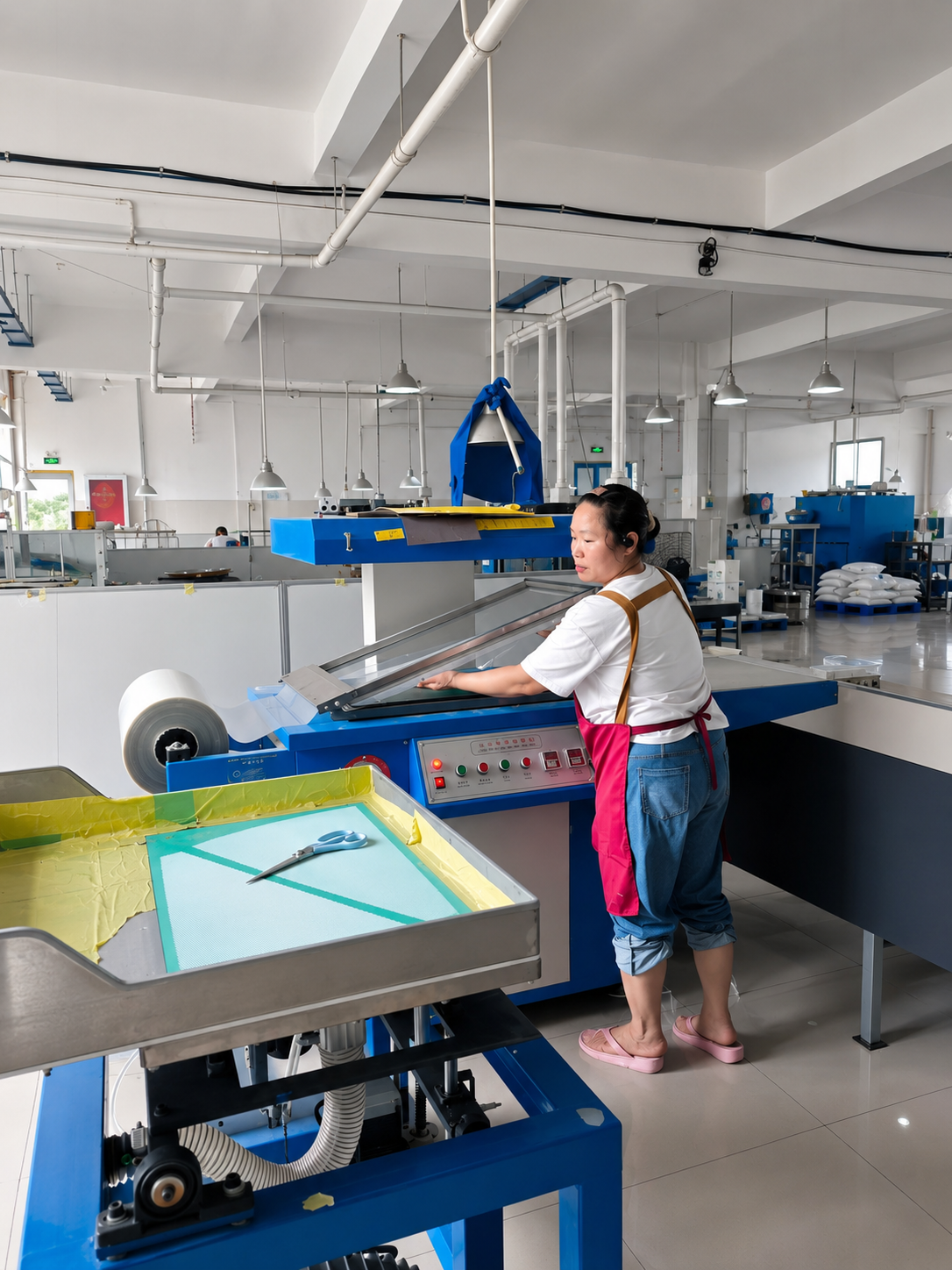
A crystal or glass stone comes out of cutting and polishing as a clear, colourless body. The colour and the metallic mirror effect are added afterwards, in a vacuum chamber. Inside the chamber the air is evacuated, a metal source is heated until it vaporises, and the metal vapour condenses onto the stone surfaces as a thin film measured in nanometres.
Because the film is deposited atom by atom rather than painted on, it follows the facet geometry precisely. That is why a well-coated stone keeps its sharp contrast between light and dark facets, while a poorly coated one looks flat and slightly milky.
The Layer Structure of a Coated Stone
A durable decorative coating is not a single film. Reputable factories build it in layers, each with a different job.
| Layer | Function | What Goes Wrong Without It |
|---|---|---|
| Base adhesion layer | Bonds the metal film to the glass surface | Coating flakes or peels at the facet edges |
| Reflective metal layer | Creates the mirror brightness | Stone looks dull and translucent instead of reflective |
| Colour / interference layer | Produces the specific shade and AB or aurora effect | Colour shifts batch to batch; AB effect looks muddy |
| Protective top layer | Seals the metal against moisture, sweat and detergent | Silver backing darkens, yellowing appears after wear |
The top layer is the one buyers most often overlook and the one that decides service life. A stone with a bright but unprotected coating can look excellent on arrival and discolour within a single season of wear.
Why the Silver Backing Is the Weak Point
On flat back stones the coating is applied to the flat underside, which is then covered by glue. This makes the backing harder to inspect and the most common source of failure. Two mechanisms dominate.
The first is silver peeling, where the metal film separates from the glass. It usually starts at the stone rim and spreads inward. The second is discolouration, where the metal oxidises and turns dark or greenish. Both are accelerated by moisture, salt from skin contact and the detergents used in garment washing.

A thick vacuum silver-plated backing is the practical countermeasure, and it is the difference between a stone rated for one-off craft use and one that survives repeated laundering on a stage costume or a pair of jeans.
Judging Coating Quality Before You Commit
Coating quality cannot be confirmed from a spec sheet alone. These checks separate a real coating line from a trading company reselling unfiltered stock.
- Ask what is coated in-house. A factory with its own vacuum coating machines can state the machine count and the coating process. A trader cannot.
- Request the patent or process documentation. Coating process development is patentable, and a manufacturer that has invested in it will hold filings for the vacuum system itself.
- Wash-test a sample. Run the stones through the washing conditions your end product will actually face, then compare backing colour against an unwashed control.
- Check batch consistency. Order the same colour twice, months apart, and compare side by side under the same light. Coating drift between batches is the most common complaint in this category.
- Inspect the facet edge. Under magnification the coating should stop cleanly and evenly. Ragged or uneven edges indicate poor adhesion or a worn masking process.
Coating Durability Claims Worth Testing
Suppliers describe coating performance with words like “durable” and “long-lasting”. These are not specifications. Convert them into something testable before you buy.
| Claim | How to Turn It into a Test |
|---|---|
| “Strong adhesion” | Tape-pull test on the coated face, then inspect for film transfer |
| “Wash resistant” | Wash a stitched sample with the detergent and temperature your garment will use |
| “Colour stable” | UV-expose a sample alongside a control for a defined period and compare |
| “Corrosion resistant” | Expose the backing to salt solution or sweat simulant, then check for darkening |
| “Consistent colour” | Compare two production batches under identical lighting |
What This Means for Your Specification
When writing a purchase specification for coated rhinestones, describe the coating explicitly rather than leaving it implicit in a colour name. State the substrate, the backing type, the intended wash environment and the acceptance test. Buyers who specify only a colour and a size give the supplier room to substitute a thinner coating at the same price, and the difference will not appear until the finished garments come back from the laundry.
For garment factories, nail supply brands and craft distributors sourcing from Pujiang — the crystal glass manufacturing centre of Zhejiang — the practical rule is simple: buy coating capability, not stones. The stones are commodity; the coating is the technology.